Architecture
How the Pro edition fits together: every container, what it reads and writes, and what sits outside the Pi. Basic and Standard are subsets. Basic runs SmokePing and mdns, and Standard adds web-admin, config-manager and PostgreSQL.
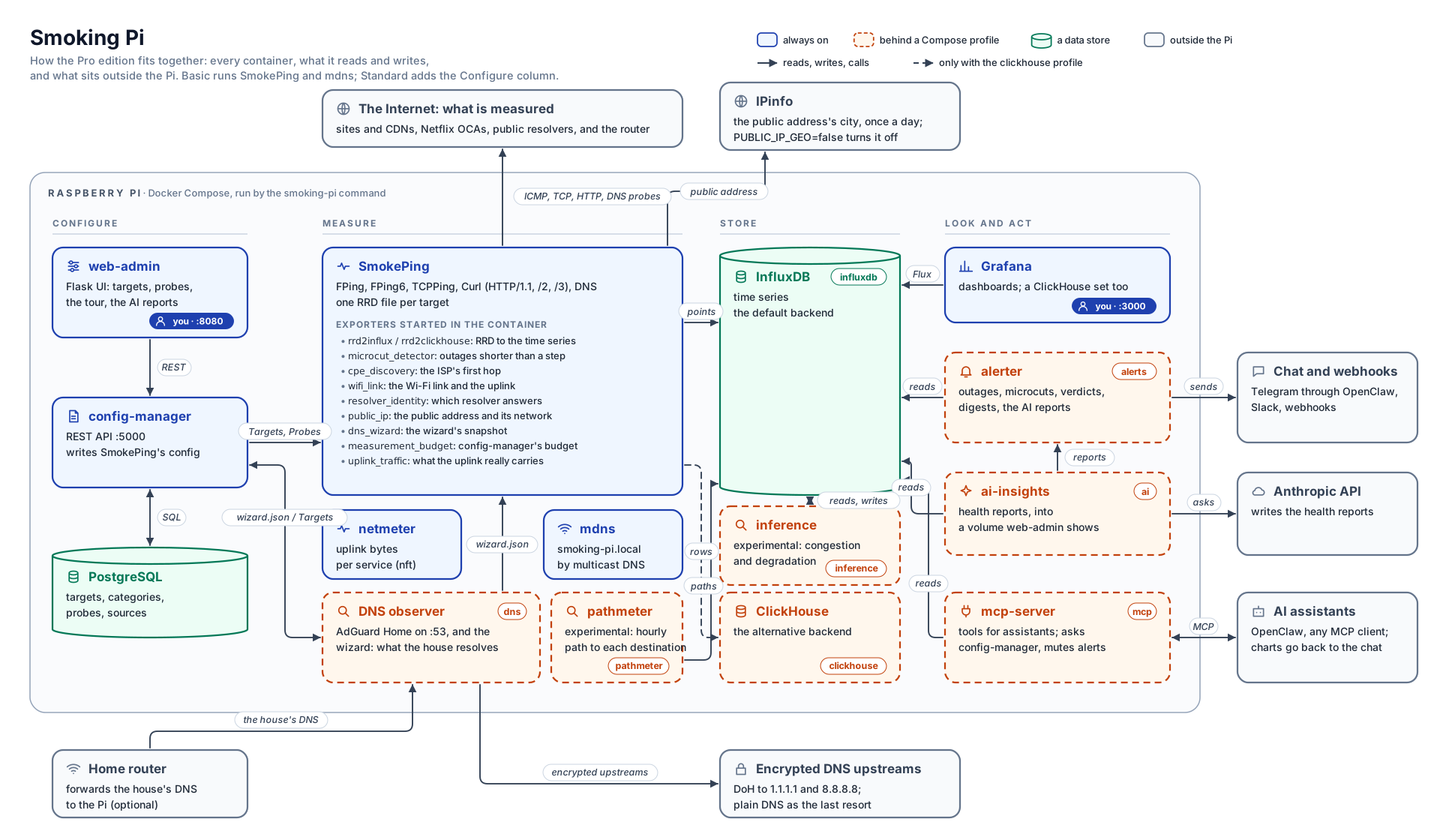
The large frame is the Raspberry Pi; everything inside it is a container
that Docker Compose runs, in four columns for the four jobs: configure,
measure, store, look and act. Solid boxes are always on. Dashed boxes run
only when their
Compose profile is on,
named by the tag on the box. InfluxDB is itself the influxdb profile: it
is the default time-series backend, and ClickHouse is the alternative. The
two you badges are where you come in: web-admin on port 8080 and Grafana
on port 3000, on the LAN or through a Cloudflare tunnel.
The paths through it
Configuration. You edit targets and probes in web-admin, which calls
config-manager's REST API. config-manager keeps them in PostgreSQL and writes
SmokePing's Targets and Probes files, then asks SmokePing to reload.
Measurement. SmokePing probes the targets (ICMP, TCP, HTTP/1.1, /2 and /3, DNS) and writes one RRD file per target. Scripts started inside the SmokePing container turn those RRDs into time series and add their own measurements: microcuts shorter than a SmokePing step, the ISP's first hop, the Wi-Fi link, which public resolver answers, and the DNS wizard's snapshot.
Looking and acting. Grafana, the alerter, ai-insights and the MCP server
all read InfluxDB. With the clickhouse profile, Grafana reads ClickHouse
through its own set of dashboards. The alerter sends alerts and weekly summaries to
Telegram (through the OpenClaw gateway), Slack or webhooks. ai-insights asks
the Anthropic API for written health reports and writes them to a shared
volume: web-admin shows them and the alerter delivers them. The MCP server
answers AI assistants such as OpenClaw, and posts charts back into the chat
through the same gateway.
Three lines are left out of the drawing to keep it readable. The MCP server asks config-manager for targets and probes. The MCP server writes alert mutes that the alerter reads, and it reads the alerter's state. web-admin reads the reports volume.
The house's DNS (optional). When the router forwards the house's DNS to
the Pi, the DNS observer resolves it through encrypted
upstreams and its wizard summarizes which services the house uses. The
wizard's wizard.json feeds an exporter in the SmokePing container and
smoking-pi dns adopt in config-manager. In the other direction, the
observer reads SmokePing's generated Targets, so the Pi's own lookups of
what it measures are not counted as the house's.
What the uplink carries. The netmeter container counts the uplink's bytes per service with a counter-only nftables table, and asks config-manager which container is which.
Experimental detectors. The inference container, behind its own profile, reads the ICMP targets' pings and loss from InfluxDB and writes back persistent congestion (Jitterbug) and loss degradation periods, which shade the Target Detail dashboard. The pathmeter container, behind its own profile too, traces the path to every measured destination once an hour and writes the paths and their changes to InfluxDB, for Target Detail's Path row.
The Pi's name. The mdns container answers for
smoking-pi.local on the LAN, so the two you badges are reachable by
name as well as by address.
The host. The smoking-pi command runs all of it with Docker Compose;
a .deb install adds a systemd unit that brings it back after a reboot.
See Command vs API scope.
Editing the drawing
The drawing comes from one spec,
tools/architecture/architecture.py,
which writes both this SVG and
architecture.excalidraw.
To sketch a change by hand, open the .excalidraw file at
excalidraw.com (menu, then Open). To change the
diagram for good, edit the spec and run:
python3 tools/architecture/architecture.py
Its tests fail when a service in any edition's Compose file is not drawn, when a box's profile disagrees with Compose, when an exporter the SmokePing container starts is not listed, or when the committed drawings are older than the spec. A new container cannot ship without appearing here.